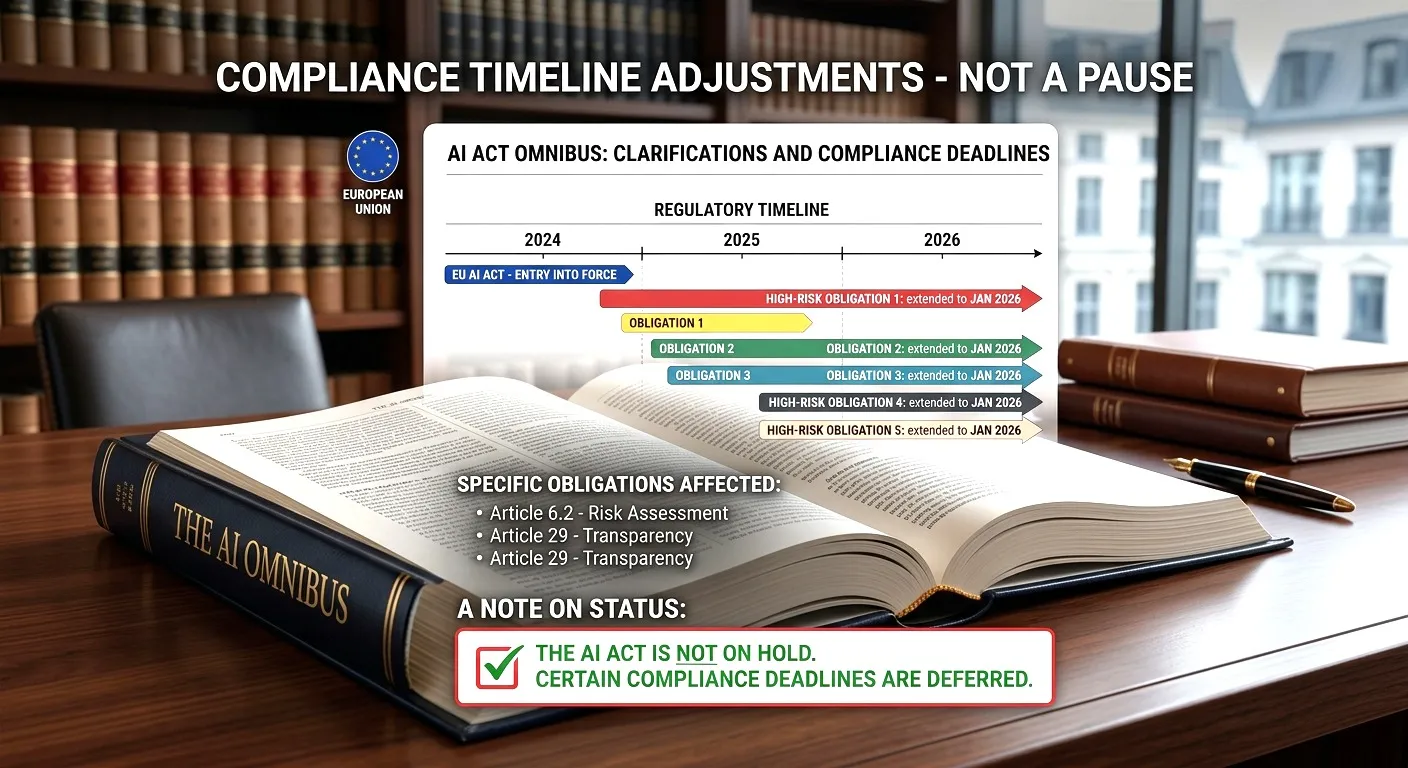
The AI Omnibus does not put the European Union Artificial Intelligence Act on hold. It simply gives companies more time on certain obligations.
By Andrés Izquierdo
Much of the public discussion has focused on the postponement of requirements applicable to high-risk AI systems in the European Union Artificial Intelligence Act **(**EU AI Act). This has created the impression that AI compliance can wait. That conclusion is mistaken.
Several core pillars of the EU AI Act remain fully applicable and enforceable today.
First, the prohibitions on unacceptable-risk AI systems have been in force since February 2025. Practices such as social scoring, certain forms of manipulative AI, the exploitation of vulnerable groups, large-scale facial image scraping, and some uses of emotion recognition technologies are already prohibited.
Second, AI literacy obligations are already a legal requirement. Organizations deploying AI systems must ensure that their personnel possess an adequate level of AI competence, taking into account the context in which those systems are used. This may prove to be one of the most consequential obligations in practice, as it affects virtually every company integrating AI into its operations.
Third, the regulatory framework applicable to general-purpose AI models remains in effect. Transparency, technical documentation, copyright-related obligations, and additional requirements for systemic-risk models continue to shape the responsibilities of providers and downstream actors alike.
What the Omnibus effectively provides is additional implementation time for certain high-risk systems. It does not alter the fundamental direction of travel.
The practical implication is straightforward.
Companies should use this period not to postpone compliance efforts, but to build internal capabilities: identify their AI systems, train their personnel, establish governance processes, and understand which obligations already apply to them.
The organizations that will adapt most successfully to the AI economy are unlikely to be those that wait for the final deadline. They will be those that treat the additional time as an opportunity to prepare before compliance becomes a competitive necessity.
The AI Act is not on pause. The foundations of European AI governance are already here.